Enterprise AI automation in 2026: how to choose an implementation partner
By Supriya · · 14 min read
AI Automation DB lists 792 approved agencies. Of those, 313 say they serve enterprise buyers (24 Nov 2026). That is a long list for any procurement team. Most enterprise AI automation projects fail on controls, not on models. This post shows how to compare partners on those controls.
Sources and method: Facts come from each agency's website and directory profile. Standards come from NIST, the European Commission and EUR-Lex. Directory counts are approved listings on 24 November 2026.
What enterprise AI automation means
Enterprise AI automation: AI agents and workflows that run business processes under audit controls. It differs from small-business automation by its controls, not its tools.
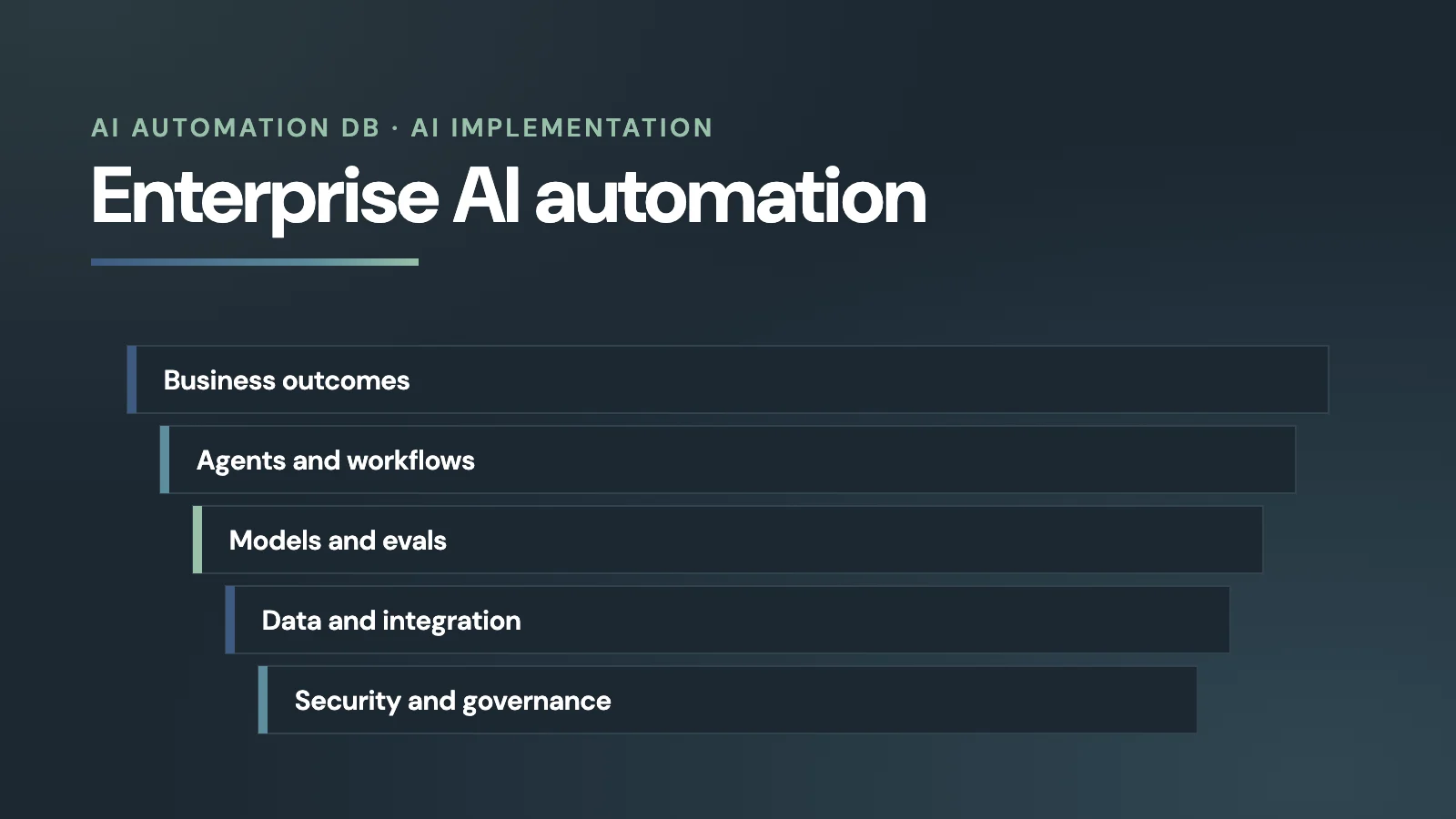
Small teams ask whether a workflow runs. Enterprise buyers ask who approved it. They ask where the data went. They ask who is on call. Enterprise automation services therefore bundle five layers. AI automation services for enterprises follow the same stack. The hero image shows them from outcomes down to controls.
- Outcomes: the metric the programme must move, such as cost per case.
- Agents and workflows: the automations themselves, with human approval steps.
- Models and evals: the LLMs used, plus tests that catch regressions.
- Data and integration: connections to ERP, CRM and document stores.
- Security and governance: access control, logs, risk reviews and policy.
Most enterprise automation solutions fail in the bottom two layers. A demo works on clean data. Production meets permissions, legacy systems and audit questions. Directory data supports this focus on services.
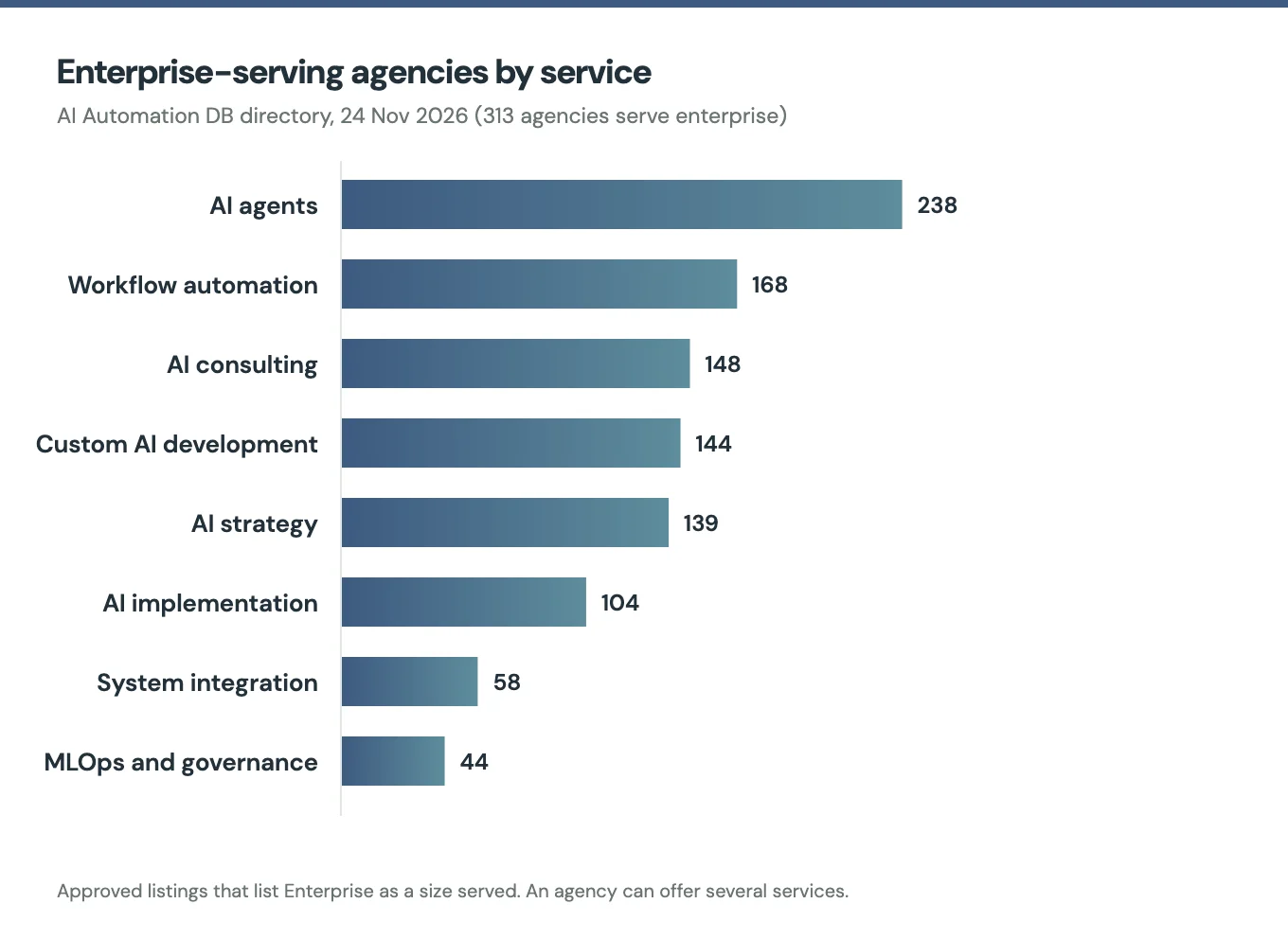
Of the 313 enterprise-serving agencies, 238 list AI agents and 168 list workflow automation. Only 44 list MLOps and AI governance. Just 18 list forward-deployed engineers. Governance skills are scarcer than build skills, so test for them.
How to choose an enterprise AI automation partner
Follow these steps in order to choose an enterprise AI partner without guesswork. How to choose an enterprise AI partner is mostly a matter of evidence. Each one produces a document you can attach to the procurement file.
- Write the outcome and the risk tier. Name one process, one metric and one baseline. Classify the risk, for example internal summaries versus customer-facing decisions. Risk tier sets how strict every later step is.
- Pick the engagement type. Decide between consulting, implementation and managed run. Our guide on AI consulting vs implementation shows the split. Enterprise AI consulting and automation often come from one firm. Many enterprise AI implementation services combine all three.
- Build a longlist from the directory. Filter AI implementation and AI consulting agencies by size served. Keep eight to ten names. Favour enterprise AI implementation partners that show evidence, not slogans.
- Send a security and data pack. Ask for SOC 2 or ISO 27001 evidence. Ask for a data flow diagram and a GDPR data processing agreement. Ask where data and model calls are processed.
- Score each partner on the scorecard below. Use two reviewers. Average the scores. Drop anyone under 11 of 14.
- Run a paid pilot on one workflow. Treat it as a proof of concept. Fix the scope, metric and exit date. Our pilot chapter covers scoping.
- Negotiate IP, SLAs and exit before scale. Intellectual property terms matter most here. Use the guide chapters on contracts and support and SLAs.
- Gate production on evals and a human owner. No workflow goes live without a test set. It also needs a rollback plan and a named owner.
The enterprise partner scorecard
This named framework scores each partner from 0 to 2 on seven criteria. A 0 means missing or unverifiable. A 1 means stated but not evidenced. A 2 means evidenced in writing. The maximum is 14. A score of 11 or more earns a pilot.
| Criterion | Ask for | A 2 looks like | Red flag |
|---|---|---|---|
| Security and compliance | SOC 2 report, ISO 27001 certificate, DPA | Current report or certificate shared under NDA | "Aligned with" wording and no document |
| Data residency | Processing regions for data and model calls | Named regions, written in the contract | "We use the cloud" |
| Model choice | List of supported models and swap process | Model-agnostic design with evals per model | One locked vendor, no exit |
| Delivery model | Team roles, location, named leads | Named lead, clear hand-over, on-site option | Junior team behind a senior sales call |
| Governance and MLOps | Eval suite, logging, risk register, human oversight | Evals gate releases and logs are exportable | No test set, no audit trail |
| IP and workflow ownership | Contract clause, repo and account ownership | You own code, prompts, workflows and accounts | Workflows live in the partner's account |
| SLAs | Uptime, response times, model-drift reviews | Written targets with credits | "Best effort" support |
Treat each row as a pass or fail test on evidence. Two criteria deserve extra attention. The first is security. The second is governance.
Security, compliance and data residency
Certifications prove a control exists. They do not prove your data is safe. Know what each one covers.
- SOC 2: an audit report from an independent CPA firm, defined by the AICPA.
- Type 1 versus Type 2: Type 1 checks design on one date. Type 2 tests operation over a period.
- ISO 27001: a certificate for an information security system, issued under ISO/IEC 27001.
- GDPR: the EU regulation on personal data of people in the EU.
Ask which subprocessors see your data. LLM providers count as subprocessors. Ask where each one processes it. Our chapter on security and compliance lists the full question set. Do not rely on a logo on a website. Ask for the report.
Governance, MLOps and the rules that apply
Governance is the work that keeps an agent safe after launch. It covers evals, logs, review queues and incident handling. Two primary sources give a shared vocabulary for it.
The NIST AI Risk Management Framework is voluntary. NIST released version 1.0 on 26 January 2023. It also published a generative AI profile in July 2024. NIST says it is revising the framework. It is organised around four functions: Govern, Map, Measure and Manage. Ask partners which function each deliverable maps to.
The EU AI Act is Regulation (EU) 2024/1689. It is binding. It uses four risk levels. The European Commission says prohibitions 1 to 8 applied from February 2025. It lists 2 December 2027 as the start of high-risk obligations. That follows the AI Omnibus changes. Check its AI Act page for current dates before you plan.
High-risk uses include worker management, credit scoring and recruitment screening. Those need risk assessment, logging, documentation and human oversight. A partner building HR or credit automation should show how it meets them. Chatbots also carry transparency duties, so users must know they talk to a machine.
Delivery models compared
Enterprise partners sell the same outcome in different shapes. AI implementation services for enterprises come in six common forms. The shape changes cost, speed and who holds the knowledge afterwards.
| Delivery model | How it works | Best when | Watch for |
|---|---|---|---|
| Fixed-scope project | Partner builds a defined system for a set fee | Scope is clear and stable | Change requests, thin hand-over |
| Product studio | A team builds and scales a product end to end | You need a new AI product | Partner-held know-how |
| Forward-deployed engineers | Engineers sit inside your team and systems | Data is messy and access is complex | Dependence on named people |
| Embedded pod | A cross-skill team works as your AI squad | You need a long programme | Cost creep, unclear exit |
| Managed service | Partner runs and improves live automations | You lack an operations team | SLA gaps, lock-in |
| Centre of excellence | Partner trains your team to run it | You want to own the capability | Slow first results |
Forward-deployed engineers are a model borrowed from data-platform vendors. The engineer works in your environment and builds against your real data. That cuts hand-off loss. It raises the stakes on contracts, because knowledge sits in a few heads. Require documentation and a shadow engineer on your side.
The AI automation by company size chapter covers why big firms favour embedded models. The sibling post on AI agent development companies compares build costs for agents.
Seven enterprise AI automation partners to compare
Each enterprise AI automation company here is an example, not a ranking. Every fact below comes from the agency's own site, read on 24 November 2026.
How we chose
This is a shortlist built from search demand, then filtered by eligibility. It is not a test. We did not run projects with any agency.
Step 1: start from demand. We took the 30 profiles most seen in Google Search among agencies serving enterprise. The window is the last 12 months. The data starts in late June 2026. Search demand is not a quality ranking.
Step 2: apply the gates, in pool order. We opened each agency's own website. It had to be an AI automation or implementation service firm. It had to be a live, verifiable company with real clients or cases. It had to have no more than 500 staff. SaaS products, courses and general web houses failed.
Step 3: take the first that pass. We skipped agencies already featured in our best AI automation agencies post. We made one exception, HatchWorks AI, for its forward-deployed engineers.
- Failed a gate: IA Agency is a marketing and web-first house. Future Agents sells a one-day bootcamp.
- Could not verify: BrainyYack and Brainpool blocked automated access. Marais Advisory served no readable page.
- Passed: the seven agencies below.
Featured, sponsored or paid status played no part. Order within a group does not rank quality.
For private equity and portfolio programmes
LightCI
LightCI is an AI product studio for private equity. Its site lists Toronto, New York and London and a 2021 founding.
- Services: enablement programmes, plus engineering of agents inside portfolio companies.
- Delivery model: a 90-day programme scoped in writing before work starts.
- Governance: the site cites evals, telemetry and logged, attributable actions.
- Notable: it cites 100+ portfolio companies. It is an Anthropic Certified Partner.
Best for: sponsors that want AI rolled out across several portfolio companies. Skip if: you are a single operating company outside private equity.
Eliza
Eliza is an enterprise AI consulting firm in San Francisco and New York. Its site names it an OpenAI Services Partner.
- Services: enablement, deployment, evaluation and optimisation of AI systems.
- Delivery model: a four-step loop: enable, build, evaluate, optimise.
- Governance: it sells evaluation systems that catch regressions and guardrails.
- Notable: case studies include a 10,000-user ChatGPT rollout for a private equity firm.
Best for: teams that need evals and cost control as products. Skip if: you want a vendor-neutral stack beyond OpenAI.
For regulated and governance-heavy programmes
Insurgence
Insurgence is an Australian AI consultancy for complex organisations. Its site cites a library of 150+ AI and automation components.
- Services: corporate services automation, education, agentic commerce and construction.
- Delivery model: solution accelerators and short build cycles of about six weeks.
- Governance: a case study describes a university AI governance framework with an asset register.
- Notable: it cites 15 to 20% of inbound service traffic automated in one case.
Best for: large Australian organisations that need governance alongside builds. Skip if: you need published certifications or pricing.
Faktion
Faktion is a Belgian AI studio. Its site says it has worked in AI for over a decade.
- Services: AI strategy, an AI product studio and AI capabilities as a service.
- Delivery model: embedded experts, plus a Claude training programme.
- Governance: it publishes on evaluation-driven development and the EU AI Act.
- Notable: it spun out two products, a chatbot platform and a document platform.
Best for: European enterprises that want an engineering-led product studio. Skip if: you need named case studies or certifications upfront.
For large implementation programmes
BotsCrew
BotsCrew is an AI transformation company. Its site says it is a Select partner in the Claude Partner Network.
- Services: AI strategy, agent development, enterprise AI solutions and adoption support.
- Delivery model: assess, build, integrate, then stay for change management.
- Security: the site lists SOC 2 aligned delivery and ISO 27001. It also lists HIPAA and GDPR.
- Notable: a case study rebuilt a failed Claude and NetSuite prototype in four weeks.
Best for: enterprises that want one partner from readiness to rollout. Skip if: you need an audit report, not "aligned" wording. Ask for it.
HatchWorks AI
HatchWorks AI is an Atlanta firm founded in 2016. Its site lists offices across the US and Latin America.
- Services: AI strategy, AI-driven development, agentic automation and change management.
- Delivery model: forward-deployed engineers and Agentic AI Pods.
- Security: the site shows a SOC 2 Type 1 badge. Ask whether Type 2 is planned.
- Notable: partners include Anthropic, Google Cloud, Databricks and OpenAI.
Best for: enterprises that want embedded engineers on a long programme. Skip if: you need a small fixed-price project.
Robiquity
Robiquity is a UK AI and low-code specialist. Its site says Avanade has announced it will acquire the firm.
- Services: agentic AI, low-code applications and technology migration.
- Delivery model: design, build, then managed services or a centre of excellence.
- Notable: the site cites £9m annualised benefit for Evri. Other cases include NHS Scotland.
- Check: ask how the Avanade deal affects your team and contract.
Best for: UK public bodies and large firms on Microsoft Power Platform. Skip if: your stack avoids low-code platforms.
How the seven compare
| Partner | Base | Delivery model | Security claim on site | Team size (profile) |
|---|---|---|---|---|
| LightCI | Toronto, New York, London | 90-day programme | Logged, attributable actions | 51-200 |
| Eliza | San Francisco, New York | Enable, build, evaluate, optimise | Not stated | 51-200 |
| Insurgence | Australia | Accelerators, six-week cycles | Not stated | 11-50 |
| Faktion | Belgium | Studio and embedded experts | Not stated | 11-50 |
| BotsCrew | United States | Assess, build, adopt | SOC 2 aligned, ISO 27001 | Not published |
| HatchWorks AI | Atlanta | Forward-deployed engineers, pods | SOC 2 Type 1 badge | Not published |
| Robiquity | United Kingdom | Build, then managed or CoE | Not stated | 51-200 |
None of the seven publishes pricing on its site. Ask each for a fixed-fee pilot quote. For a wider view, browse AI implementation partners or enterprise AI audit agencies.
Where enterprise programmes go wrong
Four failure modes recur. Each maps to a scorecard row.
- Pilot without a controls plan. The demo ships, then security blocks it. Fix it with step 4.
- No evals. A model update changes outputs and nobody notices. Gate releases on a test set.
- Partner-held workflows. Exit means a rebuild. Our chapter on ownership and lock-in lists the terms.
- Single-model lock-in. One provider changes pricing or retires a model. A model-agnostic design limits the damage.
Budgeting is the other trap. Our post on custom AI development cost shows how costs add up. For strategy-stage buyers, see AI strategy consulting.
Related guides: comparing proposals, contracts and support and SLAs.
Frequently asked questions
What is enterprise AI automation?
Enterprise AI automation is AI agents and workflows run under audit controls. It adds access control, logging, human approval steps and support terms to ordinary automation. The controls are what separate it from small-business automation.
How do I choose an enterprise AI implementation partner?
Score each partner on seven criteria. They cover security, residency, models, delivery, governance, IP and SLAs. Use evidence such as reports and contract clauses. Drop low scorers. Then run a paid pilot on one workflow before you commit to a programme.
Which is the best AI automation consulting firm for enterprises?
No single firm is best for every enterprise. LightCI suits private equity portfolios. Insurgence suits governance-heavy programmes. HatchWorks AI suits embedded engineering. Match the firm to your delivery model and risk tier. Then compare written scopes from two or three.
What do enterprise AI automation services cost?
Most enterprise partners do not publish prices. None of the seven agencies here lists fees on its site. Expect a scoped quote after discovery. Ask for a fixed-fee pilot first. Then compare the run cost of the live system.
Which security certifications should an enterprise AI partner hold?
Look for a SOC 2 report and an ISO 27001 certificate. Prefer SOC 2 Type 2, which tests controls over time. Add a GDPR data processing agreement if you handle EU personal data. Ask for documents, not badges.
What are forward-deployed engineers in AI projects?
Forward-deployed engineers are partner engineers who work inside your team and systems. They build against your real data and access. The model cuts hand-off loss. It raises dependence on named people, so require documentation and a shadow engineer.
Do the NIST AI RMF and EU AI Act apply to automation partners?
The NIST AI RMF is voluntary and gives a shared risk vocabulary. The EU AI Act is binding for covered uses. High-risk obligations start on 2 December 2027, per the European Commission. Ask partners how their deliverables map to both.
Who should own the AI workflows a partner builds?
You should own the code, prompts, workflows and accounts. Write it into the contract. Confirm the platform account is in your name. Our chapter on contracts and exit terms lists the clauses to request.
The bottom line
Enterprise AI automation succeeds or fails on controls, not on demos. Score partners on security, governance, ownership and support, then pilot once.
Agencies in this post
LightCI
Toronto, Canada
AI product studio for private equity
Insurgence
Melbourne, Australia
Accelerating intelligence. Making work matter.

BotsCrew
San Francisco, United States
We create AI agents — bespoke AI development services trusted by Fortune 500 companies.
Robiquity
Manchester, United Kingdom
AI-first solutions for faster, smarter more productive organisations
Eliza
New York, United States
Intelligence that compounds

Faktion
Antwerp, Belgium
AI Product Studio: tailor-made AI that actually delivers

HatchWorks AI
Atlanta, United States
Less AI hype. More results. Enterprise AI transformation, strategy, and agentic AI development.