10 AI agent development companies in 2026, and what a build costs
By Supriya · · 17 min read
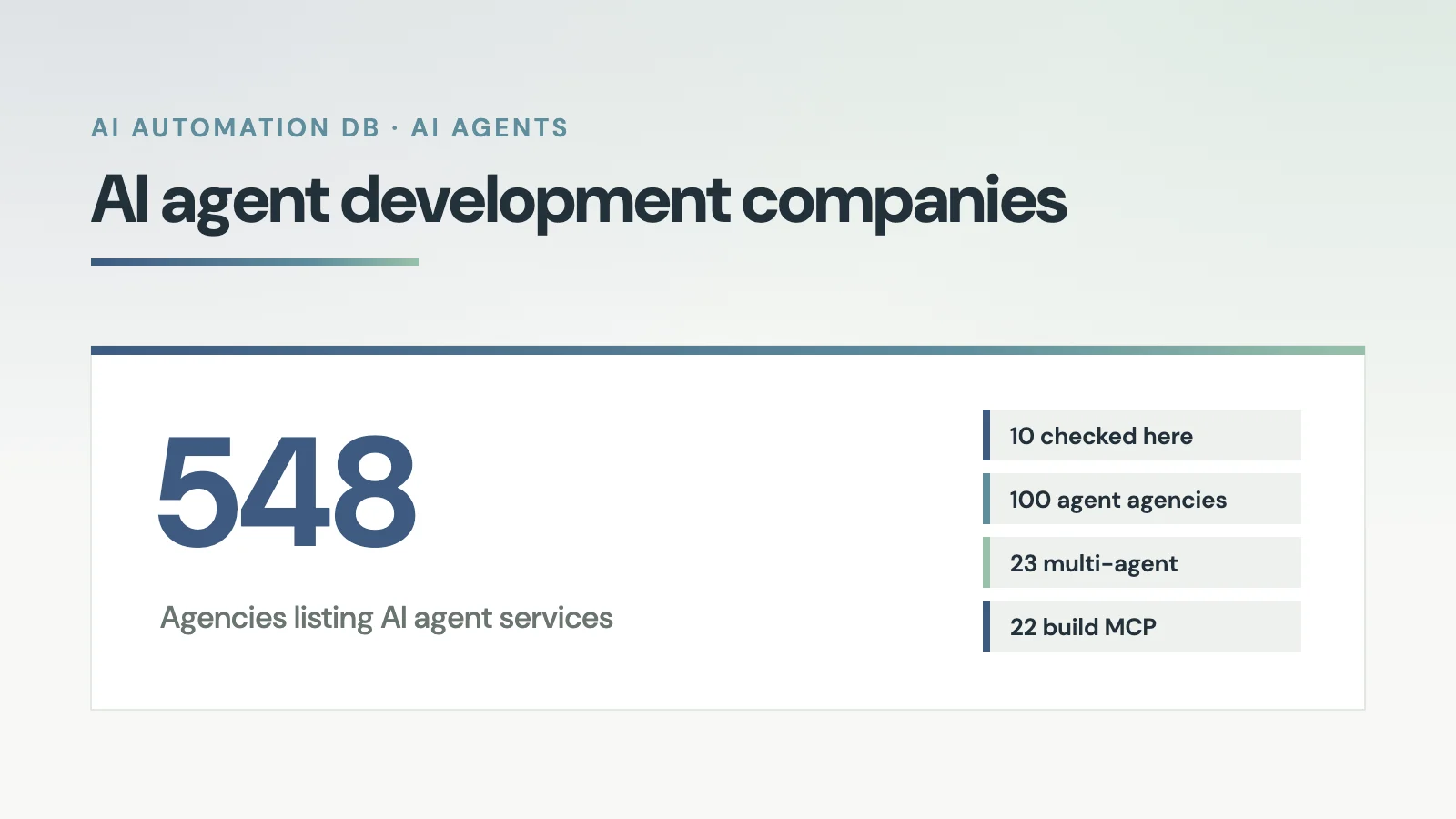
AI Automation DB lists 792 approved agencies (24 Nov 2026). Of those, 548 offer AI agents. 100 are typed as an AI agent agency. Another 23 list multi-agent systems. That is too many to compare by hand. This post picks ten to compare and explains how they were chosen. It also covers how agents work and what they cost to build and run.
Sources and method: Facts come from each company's website and AI Automation DB profile. We checked them on 24 November 2026. Directory counts are approved listings on that date. A company can sit in several categories.
The 10 AI agent development companies at a glance
Pick a company that matches your size and risk. The table follows the order of the sections below. It groups companies by buyer type. It does not rank quality.
| Company | HQ | Best for | Published pricing | Team size |
|---|---|---|---|---|
| AlphaCorp AI | Rio de Janeiro, Brazil | Custom agents and RAG | Not on site; $5,000+ minimum per profile | 1-10 |
| Trilles AI | St. Petersburg, US | Agentic automation with evals | Not published | 10-20 |
| QuantumXL | Manchester, UK | Senior-led custom agents | Not published | 1-10 |
| Crux Digits | Nieuwegein, Netherlands | Fixed-price agent builds | €2,500 audit, €20,000 MVP | Not published |
| Teamvoy | Lviv, Ukraine | Regulated and legacy systems | Custom quote | 51-200 |
| Robiquity | Manchester, UK | Agents plus low-code | Not on site; $50,000+ minimum per profile | 51-200 |
| Faktion | Antwerp, Belgium | Multi-agent knowledge systems | Not published | 11-50 |
| BotsCrew | San Francisco, US | Claude and MCP builds | Not published | Not published |
| Eliza | New York, US | Evals and cost control | Not published | 51-200 |
| The JADA Squad | Dubai, UAE | Agents inside your cloud | Model published, no amounts | 11-50 |
How we chose
This is a shortlist built from search demand, then filtered. It is not a test. We ran no project with any company.
Step 1: start from demand. We took the 30 agent profiles most seen in Google Search. The window is the last 12 months. The data starts in late June 2026. These are the profiles buyers see most. That says nothing about quality.
Step 2: apply three gates, in pool order. We opened each company's own website. A company had to pass all three gates.
- Its core business is AI agents or AI implementation. SaaS products, courses, personal brands and solo freelancers fail.
- It is a live, verifiable company. It shows a name, contact details and real case studies or clients.
- It has no more than 500 staff.
Step 3: take the first ten that pass. We worked down the pool and stopped at ten. Several failed a gate. Ronins and EGGKNITE are growth and web agencies. SuperDupr is an AI-plus-web studio whose work page shows its own products. The AI Agency USA, Integraite, Avanai and Insurgence name no clients. Melbourne AI Agents shows no named client work. Future Agents and AI Founders HQ lead with training. BrainYack blocked our requests. ConsultingWhiz did not load.
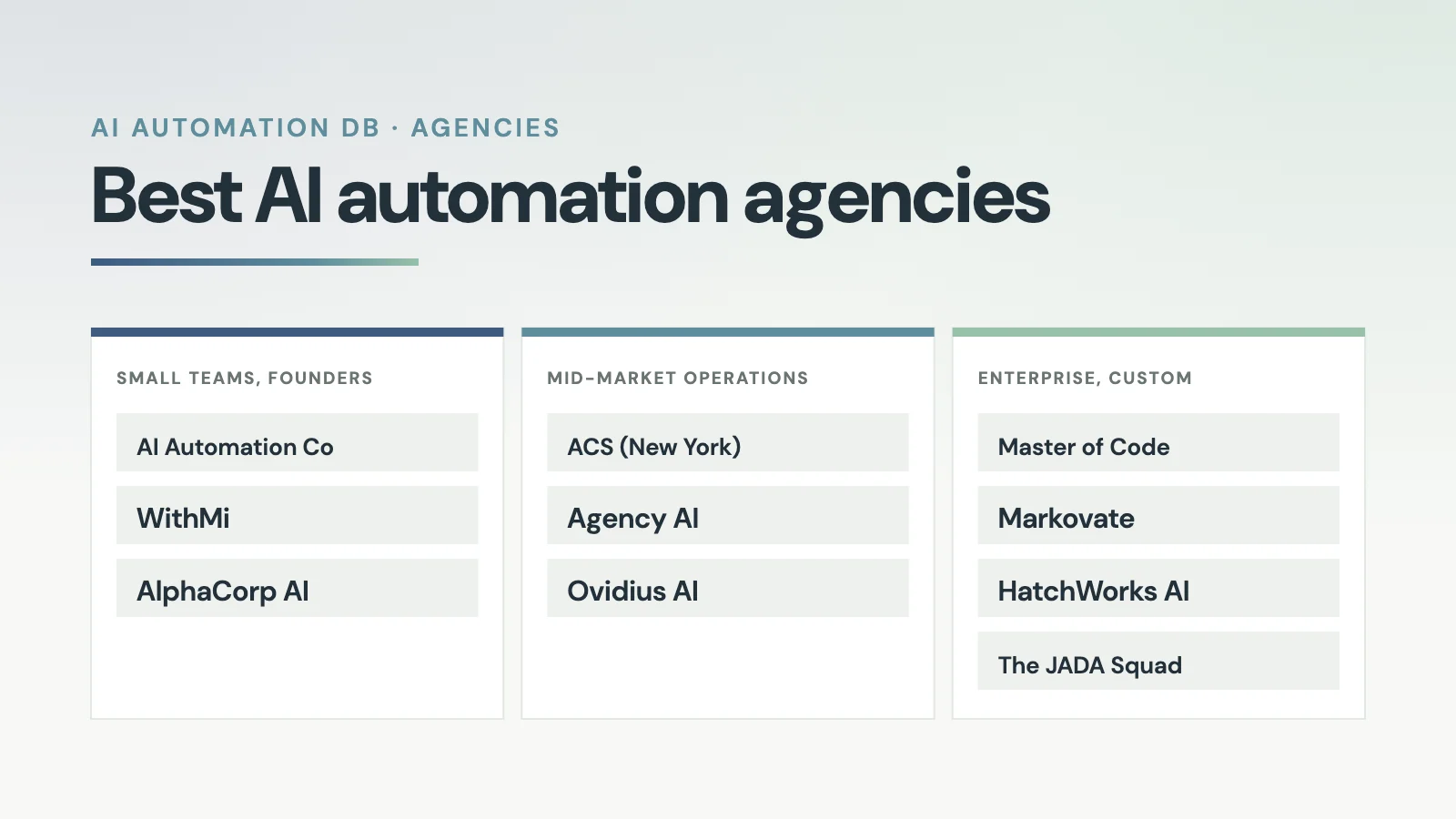
We also skipped four agencies from our roundup of the best AI automation agencies. They were Master of Code, HatchWorks AI, Ovidius AI and Markovate. We did this to widen the choice. Two agencies from that roundup stay in, as clear fits for agents.
Featured, sponsored and paid status played no part. Order within a group is not a ranking. For more, see the AI agent agencies directory or the AI agents hub.
What an AI agent is in practice
AI agent: a system where an LLM picks its next step and calls tools. Anthropic calls the alternative a workflow. A workflow follows predefined code paths.
Anthropic's engineering team says agents are typically just LLMs using tools in a loop. That loop is the whole mechanism. Every AI agent development company builds around four parts.
- Model: the LLM that reads the task and picks the next action.
- Tools: functions the model can call, such as a CRM lookup.
- Memory: the context the model sees each step, plus any saved store.
- Guardrails: limits on what the agent may do, with approval steps for risky actions.
How the loop works
Claude's tool use, also called tool calling, shows the pattern. The model returns a structured call with stop reason tool_use. Your code runs the tool. You send back a tool_result block. The model then continues or answers. Here is a simplified loop.
messages = [{"role": "user", "content": task}]
while True:
    reply = client.messages.create(
        model=MODEL, max_tokens=1024, tools=TOOLS, messages=messages)
    if reply.stop_reason != "tool_use":
        break  # the model has finished
    messages.append({"role": "assistant", "content": reply.content})
    # run_tool returns one tool_result block per tool_use block
    results = [run_tool(b) for b in reply.content if b.type == "tool_use"]
    messages.append({"role": "user", "content": results})
This agent loop has two consequences. Each pass re-sends the whole conversation, so cost grows with loop length. And each tool call can do harm. Write access needs a gate.
Workflow or agent
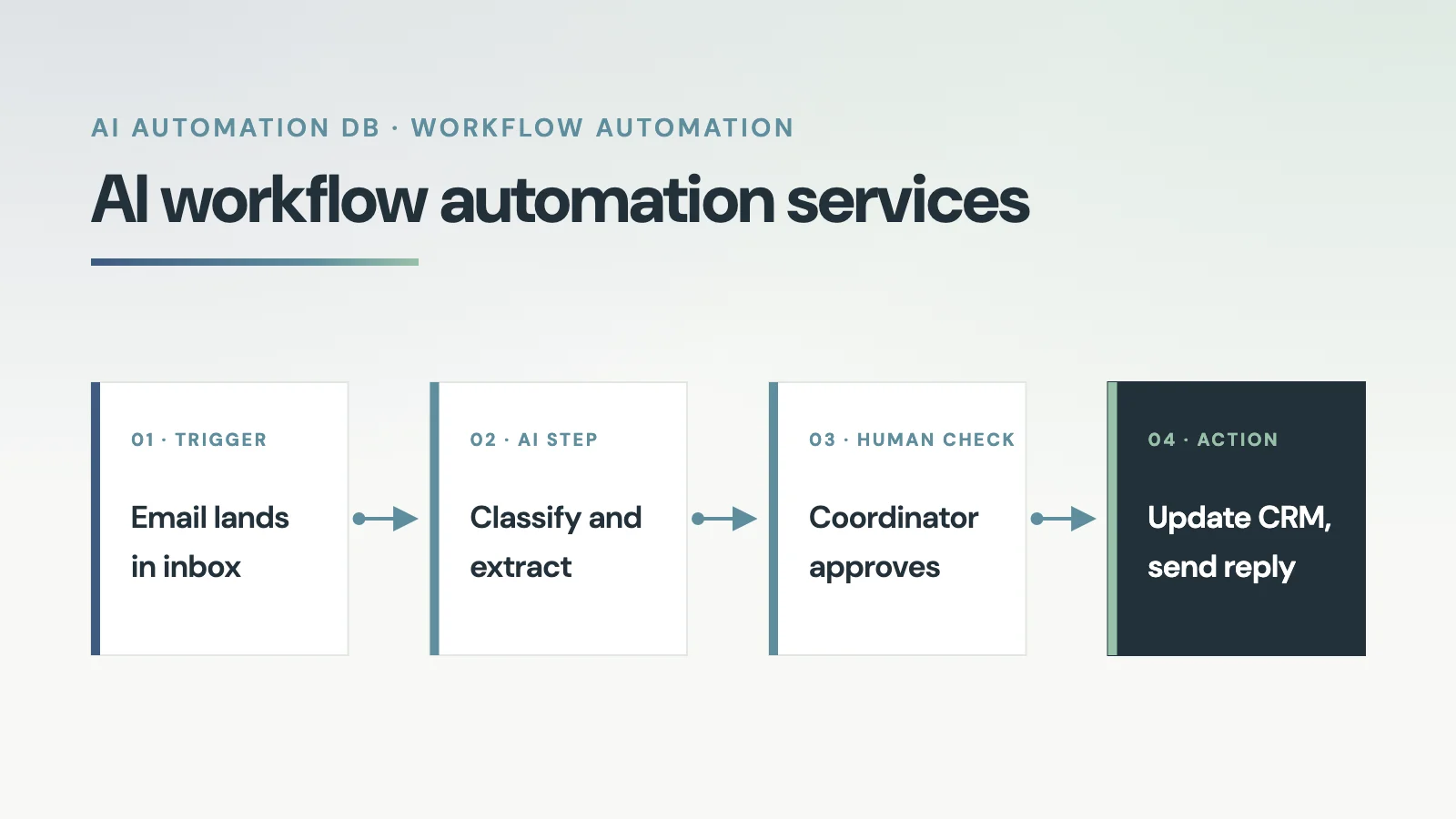
Anthropic advises the simplest solution possible. Agents trade latency and cost for flexibility. Use a workflow when the steps are known. Use an agent when the path depends on what the model finds. That is the core of AI agent vs workflow automation. Our post on AI workflow automation services covers the fixed-path case.
Single agent or multi-agent
A single agent has one loop and one set of tools. A multi-agent system splits work across several agents. A manager agent can hand tasks to specialists. The OpenAI Agents SDK calls this pattern handoffs. Multi-agent systems development helps when tool sets or permissions must stay separate. They also multiply model calls. Browse the multi-agent systems hub to find agencies that list it. Ask any agency that ships multi-agent systems to production how it tests the handoffs.
Frameworks and protocols
Most agencies pick from a few building blocks for orchestration.
- LangGraph: a low-level framework for stateful agents. Its docs list durable execution, human-in-the-loop pauses and memory.
- OpenAI Agents SDK: a small set of primitives. They are agents, handoffs and guardrails, with built-in tracing.
- Anthropic tool use: the raw API pattern above. It needs no framework.
- Model Context Protocol: an open standard for connecting agents to tools and data. The MCP site likens it to a USB-C port for AI apps.
AlphaCorp AI lists LangGraph, LangChain, LlamaIndex, CrewAI and n8n on its stack page. BotsCrew rebuilt a failed Claude and NetSuite MCP prototype for a client. Find more in the directory under MCP server development.
For startups and small teams
Small teams need a fast first agent and engineers on the first call. These three suit a single, well-defined job.
1. AlphaCorp AI
AlphaCorp AI is a small Rio de Janeiro studio. Its site calls it an AI agent development company. It builds agents, retrieval systems and fine-tuned models.
- Services: AI agent development, RAG systems, LLM work and MLOps.
- Pricing: not published on the site. The profile lists a $5,000 minimum and $25 to $49 per hour, from Clutch.
- Team and HQ: Rio de Janeiro. The profile lists 1-10 staff and a 2024 founding year.
- Stack: LangGraph, LangChain, CrewAI, n8n, and models from Anthropic, OpenAI and others.
- Notable: clients include Versar, Gynisus, CampusReel, Luniq and HospitalityFlow. It claims two to four weeks from idea to production.
Best for: founders who want an engineer-led team to build custom agents. Skip if: you need a public price list or a large delivery team.
2. Trilles AI
Trilles AI is a founder-led firm in St. Petersburg, Florida. Its site puts agentic AI first. It lists single-purpose agents, multi-agent systems, tool use and memory.
- Services: agentic AI, automation, voice agents, chat agents and custom AI.
- Pricing: not published. The profile says plans are fixed-price after a scoping call. It lists a $5,000 minimum from Clutch.
- Team and HQ: St. Petersburg. The profile lists 10-20 staff.
- Notable: its about page says every system ships with an evaluation harness. Clients own code, prompts and accounts. Case studies name Darfoor Law Firm and Powerbanc Lending.
Best for: small firms that want agents with built-in evals and clear ownership. Skip if: you need a team above 20 or published prices.
3. QuantumXL
QuantumXL is a UK custom AI studio. Its site lists offices in Manchester and London. It says the engineers who scope a project also build it.
- Services: agentic AI development, generative AI, machine learning and AI consulting.
- Pricing: not published. Its contact form offers budget bands from under £10,000 to £100,000-plus.
- Team and HQ: Manchester. The profile lists 1-10 staff and a 2025 founding year.
- Notable: case studies name Microsoft, Siemens Healthineers and AkzoNobel. The site says its senior team stays accountable after launch.
Best for: UK firms that want one senior team from scoping to support. Skip if: you need a public price or a long track record. The profile lists a 2025 founding.
For mid-market teams and regulated systems
These three suit firms with existing systems to connect. Two publish fixed scopes. All three work on regulated or legacy stacks.
4. Crux Digits
Crux Digits is a Dutch AI consultancy and engineering firm. Its pricing page is the clearest of the ten.
- Services: AI agents, AI implementation, data engineering, computer vision and custom software.
- Pricing (as of November 2026): a 1-2 week audit at €2,500. A 4-6 week MVP at €20,000. Production from €50,000. All exclude VAT.
- Team and HQ: Nieuwegein. Team size is not published.
- Notable: the audit fee is credited if you buy the MVP within 60 days. Code, model, prompts and test set transfer to you. It lists 13 case studies.
Best for: European mid-market firms that want fixed prices and EU AI Act checks. Skip if: you need a large global team or US-dollar pricing.
5. Teamvoy
Teamvoy is a Lviv engineering firm founded in 2013. AI agents are one line of a wider engineering offer. Its site also covers legacy modernisation and compliance work.
- Services: AI agent development, AI integration, LLMOps and legacy modernisation.
- Pricing: custom quote. The profile lists a $25,000 minimum and $50 to $99 per hour, from Clutch.
- Team and HQ: Lviv. The profile lists 51-200 staff.
- Stack: it says it partners with OpenAI, Anthropic, AWS, Zapier and Databricks.
- Notable: it cites Nasdaq, OSL and Panasonic Avionics as clients. It names DORA, HIPAA and SOC 2 controls. Engagements average four years, per the site.
Best for: fintech, insurance and healthcare teams with legacy cores. Skip if: you want a narrow agent studio or a small first project.
6. Robiquity
Robiquity is a Manchester firm founded in 2016. Its site pairs agentic AI with low-code on Microsoft platforms. The homepage announces that Avanade will acquire it.
- Services: agentic AI, unstructured data processing, case management and low-code apps.
- Pricing: not on the site. The profile lists a $50,000 minimum and $300-plus per hour, from Clutch.
- Team and HQ: Manchester. The profile lists 51-200 staff.
- Stack: Power Platform and UiPath, per the profile.
- Notable: the site cites Evri, NHS Scotland, the Ministry of Justice and Durham Police. It reports £9m annualised benefits for Evri.
Best for: UK public-sector and enterprise teams on Microsoft platforms. Skip if: your stack is not Microsoft or you want a small project.
For enterprise programmes
Enterprise buyers need governance, evals and delivery capacity. These four sell larger programmes and rarely publish prices. They suit anyone seeking custom agentic AI development services at scale.
7. Faktion
Faktion is an AI product studio in Antwerp, founded in 2016. Its site describes a multi-agent framework and evaluation-driven development. Securex took a majority stake, per a news item on its site.
- Services: AI strategy, an AI product studio, embedded AI teams and generative AI.
- Pricing: not published.
- Team and HQ: Antwerp. The profile lists 11-50 staff.
- Notable: case studies name TOMRA Food, Proximus, Argenta, SD Worx and Ferranti. The Ferranti case describes a multi-agent knowledge assistant.
Best for: Belgian and European enterprises that need multi-agent knowledge systems. Skip if: you want a fixed price or a small pilot.
8. BotsCrew
BotsCrew is a conversational AI firm founded in 2016. Its site says it is a Select partner in the Claude Partner Network. It claims 200-plus AI projects shipped.
- Services: AI strategy, agent development, Claude development and enterprise AI.
- Pricing: not published.
- Team and HQ: San Francisco per the profile. Team size is not published.
- Notable: it rebuilt a failed Claude and NetSuite MCP prototype in four weeks. It reports $140,000 in annual savings. Up to half of requests are automated.
Best for: enterprises that want Claude-based agents tied to an ERP. Skip if: you need public pricing or a small team.
9. Eliza
Eliza is an enterprise AI firm and an OpenAI services partner. Its site lists offices in San Francisco and New York. It sells enablement, deployment, evaluation and optimisation.
- Services: custom software and agentic systems, evaluation systems and cost optimisation.
- Pricing: not published.
- Team and HQ: New York. The profile lists 51-200 staff.
- Notable: case studies cover internal automation agents for a $50 billion consumer goods firm. Others cover private equity deal intelligence and regulated RAG for an advisory firm.
Best for: enterprises that want evals and spend control built into agents. Skip if: you want a non-OpenAI stack or a small fixed-price pilot.
10. The JADA Squad
The JADA Squad is a Dubai firm. It builds and runs custom enterprise agents. Its site lists assess, build and manage engagements.
- Services: agent design and build, adoption programmes and forward deployed engineers.
- Pricing: the profile lists the model, not amounts. Assess is a fixed fee. Build is a monthly retainer per expert pod.
- Team and HQ: Dubai. The profile lists 11-50 staff and a 2024 founding year.
- Notable: the site says human approvals, escalation triggers and audit trails are built in. It says everything built belongs to the client.
Best for: large Gulf organisations that want agents inside their own environment. Skip if: you need named references or public prices. Its testimonials are unnamed.
What an AI agent build costs
Most agent builders do not publish prices. Here is what the ones we opened do publish.
| Source | What it publishes | Scope |
|---|---|---|
| Crux Digits | €2,500 audit, €20,000 MVP, €50,000+ production | Fixed prices, excl. VAT |
| SuperDupr | $5,000 to $10,000 for a chatbot or voice agent | Custom build, own site FAQ |
| SuperDupr | $25,000 to $50,000+ for multi-agent systems | End-to-end workflows |
| Melbourne AI Agents | $300 per month ex GST, $490 setup | Managed marketing agent |
SuperDupr and Melbourne AI Agents did not pass our gates. Their prices are still published and useful as reference points. SuperDupr states them in its FAQ. Melbourne AI Agents uses its managed agents page. Prices are as of November 2026.
Published pricing is thin. Of 548 agencies listing AI agents, 295 have a pricing note. Only 100 state a minimum project size. Of those, 56 cite Clutch.
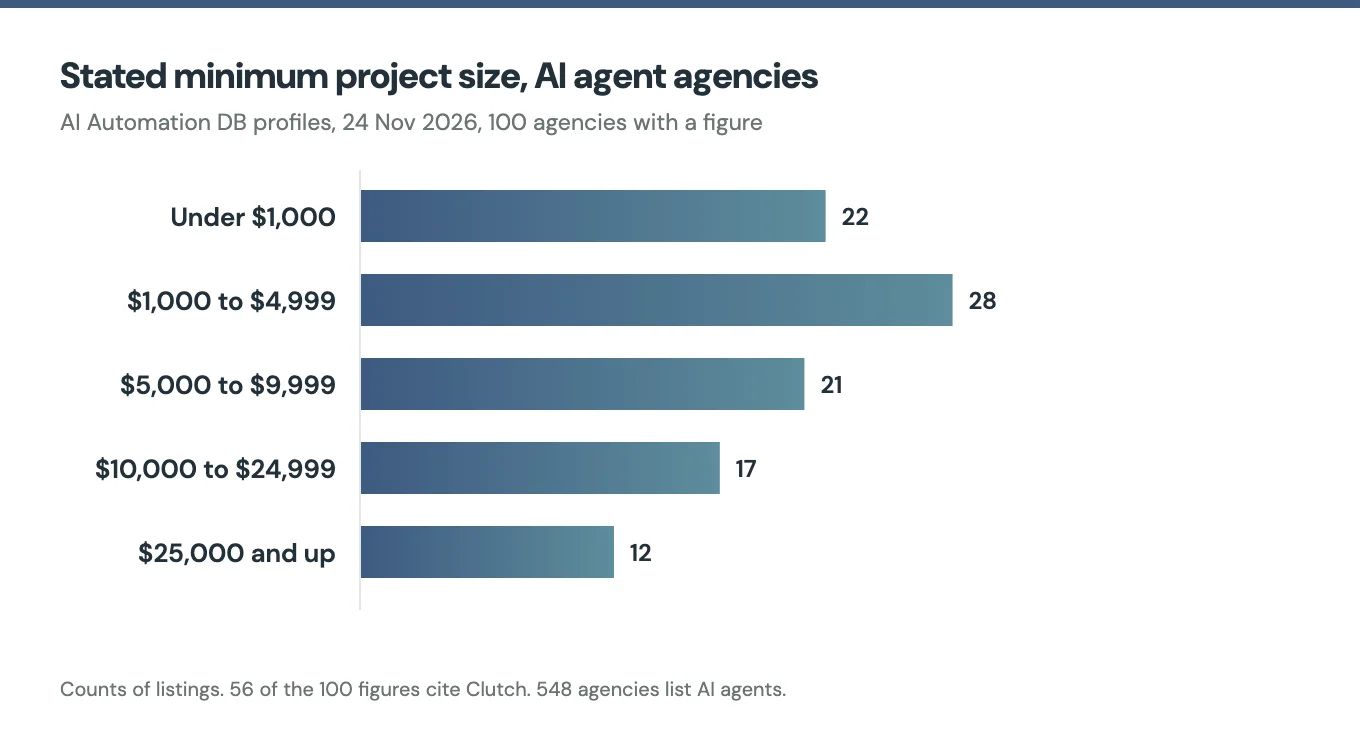
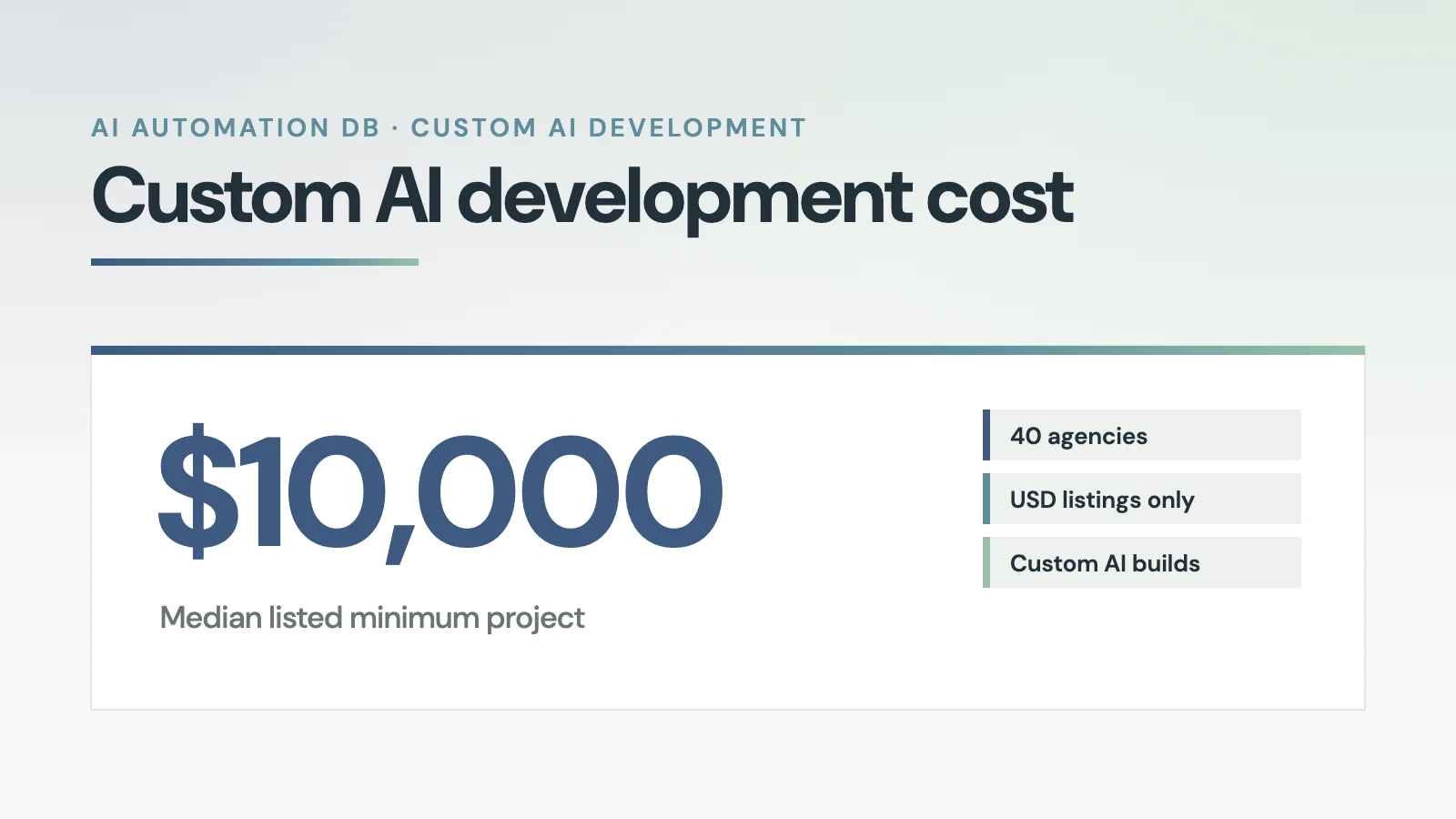
The median stated minimum is $3,750. Twelve agencies state $25,000 or more. Among our ten, the profiles cite $5,000 for AlphaCorp AI and Trilles AI. They cite $25,000 for Teamvoy and $50,000 for Robiquity. Treat these as entry points. They are not quotes. Our post on custom AI development cost breaks down fees for wider builds. The guide chapter on AI automation agency pricing explains the fee models.
What an agent costs to run: worked math
AI agent running costs differ from the build fee. The build fee is paid once. Model usage is paid on every run. Agent loops re-send context each step, so input tokens grow fast.
Formula: input = nS + h·n(n − 1)/2. Here n is steps. S is the base prompt. h is tokens added per step.
Assumptions: an illustrative support agent. The base prompt with tool definitions is 3,000 tokens (S). Each step adds 950 tokens (h) of model output and tool results. Each step outputs 150 tokens. We use Claude Sonnet 5.5 at $2 input and $10 output per million tokens. Anthropic bills tool use as ordinary tokens, as of November 2026.
For six steps, input is 18,000 + 950 × 15 = 32,250 tokens. Output is 900 tokens.
- Input cost: 32,250 tokens × $2 ÷ 1M = $0.0645.
- Output cost: 900 tokens × $10 ÷ 1M = $0.009.
- Total: $0.0735 per run.
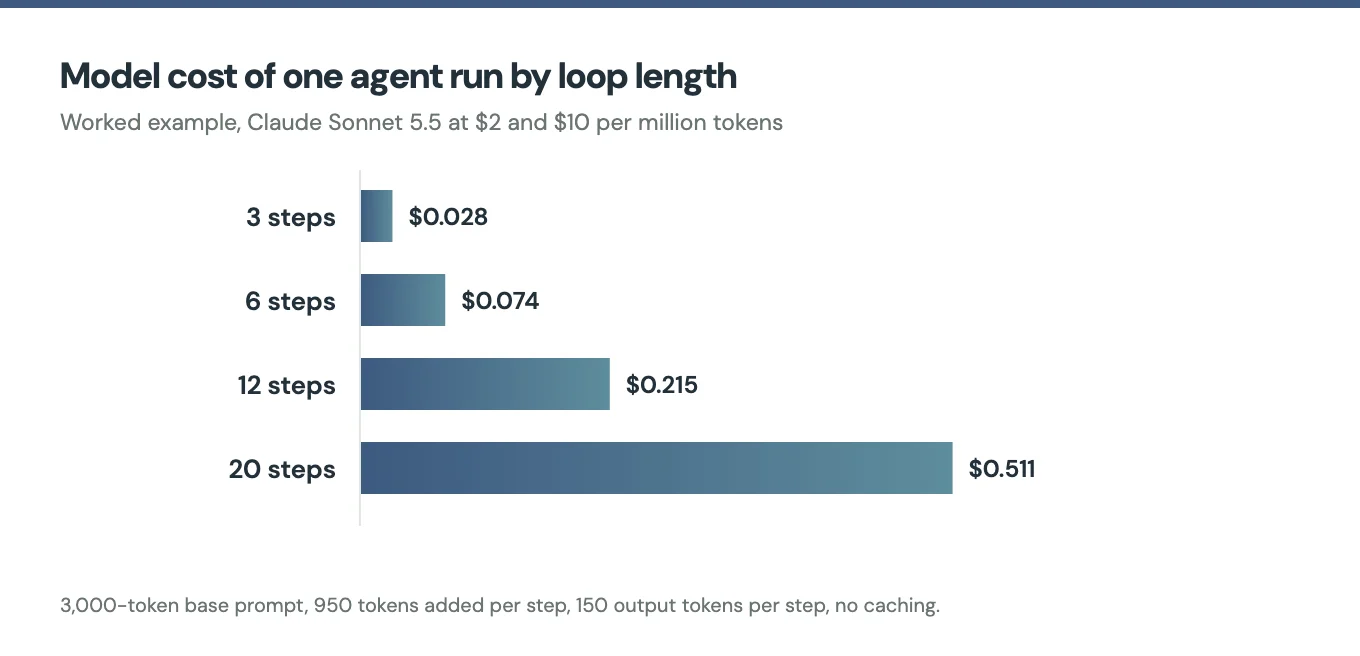
Doubling the loop from six to twelve steps nearly triples the cost. That is $0.2154 against $0.0735. Re-sending context makes cost grow with the square of the steps.
Prompt caching and model choice
Prompt caching bills cache reads at $0.10 per million tokens on Sonnet 5.5. Cache writes cost $2.50 per million. Apply that to the six-step run. Step one writes 3,000 tokens. Each later step reads the prior context and writes 950 new tokens.
- Cache reads: 24,500 tokens × $0.10 ÷ 1M = $0.00245.
- Cache writes: 7,750 tokens × $2.50 ÷ 1M = $0.0194.
- Output: $0.009.
- Total: about $0.031 per run, 58% below the uncached run.
Model choice matters too. Claude Opus 5.5 lists at $4 and $20 per million tokens. The same uncached six-step run costs $0.147 on Opus 5.5. That is twice the Sonnet price.
First-year cost at 10,000 runs a month
Take a multi-agent build at SuperDupr's published range of $25,000 to $50,000. Run it at 10,000 six-step runs a month. Treat the whole system as one loop of this size. If three agents each run this loop, multiply the run cost by three.
| Cost line | Low case | High case |
|---|---|---|
| Build fee | $25,000 | $50,000 |
| Model usage, 12 months | $3,699 (cached) | $8,820 (uncached) |
| Year-one total | $28,699 | $58,820 |
Model usage is 10,000 × $0.0308 × 12 for the low case. It is 10,000 × $0.0735 × 12 for the high case. This excludes monitoring, support retainers and tool fees. Ask each agency to price those. Compare the total to the hours saved. Our guide on measuring AI automation ROI shows how to set a baseline.
How to choose an AI agent development company
Use this checklist to compare custom AI agent development services. It suits any AI agents agency. We call it the four-layer test. It follows the four parts of an agent.
| Layer | Ask the agency | Good sign |
|---|---|---|
| Model | Which models, and can we swap them? | Model-agnostic design |
| Tools | Which actions can the agent take? | Read-only first, approvals for writes |
| Memory | What is stored, and where? | Data stays in your cloud |
| Guardrails and evals | How do you test each release? | A written eval set you keep |
Then check three contract points. Ask who owns the code, prompts and accounts. Ask who pays when the model bill spikes. Ask who monitors the agent after launch. Our guide chapters on ownership and lock-in and questions to ask list clauses. Start with a proof of concept through an AI automation pilot. For larger programmes, see our post on enterprise AI automation.
The best AI agent development company for you matches your stack, risk and budget. Use the opening table to pick two or three names. Check that each one publishes how it bills.
Related guides: custom AI development cost, best AI automation agencies, evaluating an agency.
Frequently asked questions
What is an AI agent development company?
An AI agent development company builds and runs software where an LLM chooses actions. It connects the agent to your systems and adds guardrails. Many also offer AI agent consulting services, evals and AI agent implementation services. Browse the AI agent agency directory to compare options.
How much does AI agent development cost?
Published prices vary widely. Crux Digits publishes a €2,500 audit, a €20,000 MVP and production from €50,000. SuperDupr publishes $5,000 to $10,000 for a single agent. It publishes $25,000 to $50,000-plus for multi-agent systems. Most agencies quote after scoping. Add model usage on top.
How much does an AI agent cost to run?
Run cost depends on loop length and model. In our worked example, a six-step run costs about $0.074 on Claude Sonnet 5.5. With prompt caching it falls to about $0.031. At 10,000 runs a month, that is roughly $308 to $735.
How to choose an AI agent development company?
Match the company to your size, stack and risk. Check named case studies and ask about evals. Ask who owns the code, prompts and accounts. Ask how model costs are capped. Then compare written scopes from two or three firms. Our four-layer test above gives the questions.
What is the difference between an AI agent and workflow automation?
A workflow follows predefined code paths. An agent lets the LLM direct its own steps and tool use. Workflows suit known, repeatable processes. Agents suit open-ended tasks where the path varies. Agents cost more per run and need stronger guardrails. Many projects combine both.
Which agency ships multi-agent systems to production?
Faktion describes a multi-agent framework with evaluation-driven development, and names Ferranti as a client. Trilles AI lists multi-agent systems among its agentic services. SuperDupr publishes multi-agent price ranges. The directory lists 23 agencies under multi-agent systems. Ask each for a production case study.
Do AI agent development services include ongoing support?
Often, but not always. The JADA Squad sells a monthly manage plan. Crux Digits includes a support period. It sells ongoing operation as a separate fixed agreement. QuantumXL says its team stays accountable after launch. Confirm monitoring, eval updates and model changes in your contract.
What should I ask a custom AI agent development company?
Ask which tools the agent can write to and who approves those actions. Ask how releases are tested and which evals you keep. Ask who owns prompts, code and accounts. Ask how a runaway model bill is handled. Ask for one production case study with a named client.
The bottom line
The best AI agent development company fits your stack, risk and budget. Compare two or three on written scope, evals and ownership terms.
Agencies in this post

AlphaCorp AI
Rio de Janeiro, Brazil
AI Agent Development Company

Trilles AI
St. Petersburg, United States
AI employees that never clock out.

QuantumXL
Manchester, United Kingdom
The Custom AI Development Company in the UK. From idea to production.

Crux Digits
Nieuwegein, Netherlands
Custom AI development, from strategy to production

Teamvoy
Lviv, Ukraine
Build AI. Modernize What's Behind It.
Robiquity
Manchester, United Kingdom
AI-first solutions for faster, smarter more productive organisations

Faktion
Antwerp, Belgium
AI Product Studio: tailor-made AI that actually delivers

BotsCrew
San Francisco, United States
We create AI agents — bespoke AI development services trusted by Fortune 500 companies.
Eliza
New York, United States
Intelligence that compounds

The JADA Squad
Dubai, United Arab Emirates
Production-grade AI Agents for your enterprise